Welcome to Qingdao Jabetter New Material Technology Co., Ltd. Official Website!

NEWS
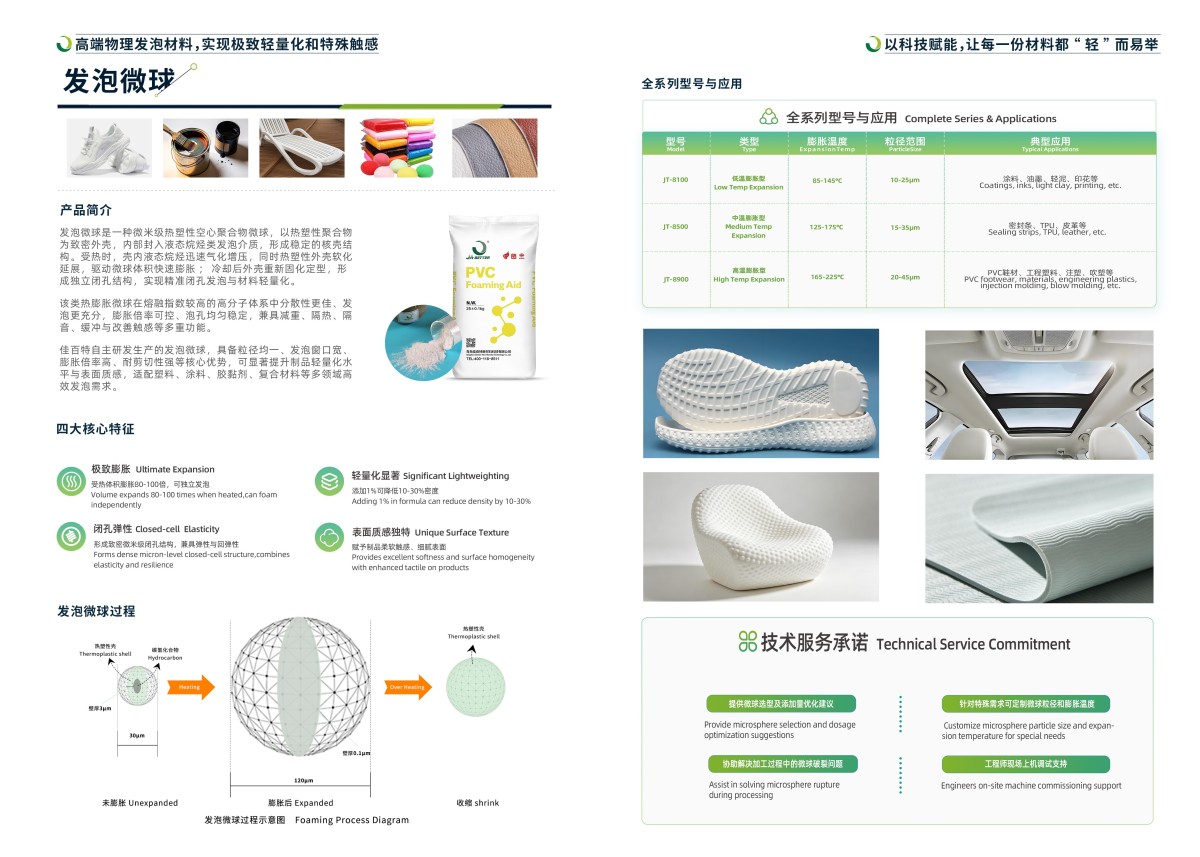
PVC shoe expandable microspheres are indispensable functional foaming additives in the modern shoemaking industry, widely applied in the production and processing of various PVC footwear products. Against the industry development trend of lightweighting and softening shoe materials, PVC shoe expandable microspheres have become the core additive choice for numerous shoe material manufacturers by virtue of their stable foaming performance. These microspheres can effectively optimize the internal structure of shoe materials, improve product texture, reduce production energy consumption and raw material loss, and help shoemaking enterprises improve quality and efficiency. Jabetter has long been deeply engaged in the field of shoe material additive production, focusing on polishing the quality of PVC shoe expandable microspheres. Relying on mature production processes, the company’s microspheres are compatible with all conventional shoemaking production lines, fully meeting the foaming demands of large-scale shoe material production.
Traditional PVC shoe material foaming processes have many drawbacks. Conventional foaming methods tend to cause uneven cell size and unbalanced foaming density in shoe materials, resulting in defects such as deformation, collapse and stiff hand feel of finished products, which seriously impair the quality of footwear products. The application of PVC shoe expandable microspheres can effectively solve these production problems. Adopting a physical foaming principle, the microspheres expand uniformly when heated to form dense and independent closed-cell structures. Shoe materials processed with PVC shoe expandable microspheres feature regularly arranged internal cells and enhanced overall structural stability, with significantly improved wear resistance and resilience. In light of the actual production conditions of the domestic shoemaking industry, Jabetter has selectively optimized the initial expansion temperature and expansion ratio of PVC shoe expandable microspheres. This enables the microspheres to adapt to various processing procedures including injection molding, extrusion and calendering, avoiding microsphere damage and premature foaming during processing.
The dispersibility of additives is a key factor affecting the quality of finished shoe products. Ordinary foaming auxiliary materials are prone to agglomeration and caking, which undermines the overall foaming effect. The PVC shoe expandable microspheres developed and produced by Jabetter boast excellent compatibility with PVC base resins, plasticizers, stabilizers and other common shoe material auxiliaries. They can achieve uniform dispersion in conventional mixing and stirring processes without additional dispersing agents, simplifying production operations. The stably dispersed microspheres ensure consistent foaming effects across all production batches of shoe materials, greatly reducing product defect rates. Meanwhile, the addition of a fixed dosage of PVC shoe expandable microspheres can effectively lower the overall density of shoe material materials and reduce the consumption of PVC resin raw materials, helping enterprises control production costs and improve the market adaptability of their products.
The shoemaking sector features diverse product categories, and different shoe products have distinct requirements for foaming effects. Products such as soft slippers, wear-resistant shoe soles and lightweight shoe material sheets all require different foaming ratios. Jabetter has built a multi-specification product system of PVC shoe expandable microspheres to meet the production needs of various PVC shoe materials, allowing enterprises to select suitable microsphere models according to product positioning. Featuring a wide processing window and high production fault tolerance, the microspheres are barely affected by minor fluctuations in equipment speed and processing temperature, delivering consistent and uniform foaming effects at all times. Finished shoe products manufactured with these microspheres have smooth and flat surfaces without pits, voids, cracks or other defects, achieving a substantial improvement in appearance quality.
Production line compatibility is a core consideration for enterprises when replacing foaming additives. Most enterprises are concerned that new additives may be incompatible with existing equipment, leading to increased process transformation costs. Through extensive on-site production tests, Jabetter has continuously optimized the particle size and shell toughness of PVC shoe expandable microspheres and enhanced their shear resistance. This makes the microspheres adaptable to all conventional shoemaking equipment, maintaining a complete structure even under high-speed working conditions and ensuring stable and consistent foaming results. Enterprises can adopt these PVC shoe expandable microspheres without major adjustments to original production processes, and rapid production launch can be realized simply by fine-tuning the formula ratio, which greatly reduces process upgrading costs. In the future, Jabetter will continue to deepen its layout in the shoe material foaming field, continuously optimize the performance of PVC shoe expandable microspheres, and provide reliable additive support for the lightweight and refined development of the shoemaking industry.
☁ 网络:http://www.jbtpvc.com/
☎WhatsApp:008618963029813
✉电子邮件:info@Jabetter.com
#PVC_stabilizer #PVC_foaming_agent#PVC_processing_aid#WPC_additive#PVC_lubricant#Chemicals#Chemical_auxiliary_agent#PVC#PVC_additives
#PVC_stabilizer #PVC_foaming_agent#PVC_processing_aid#WPC_additive#PVC_lubricant#Chemicals#Chemical_auxiliary_agent#PVC#PVC_additives
