Welcome to Qingdao Jabetter New Material Technology Co., Ltd. Official Website!

NEWS
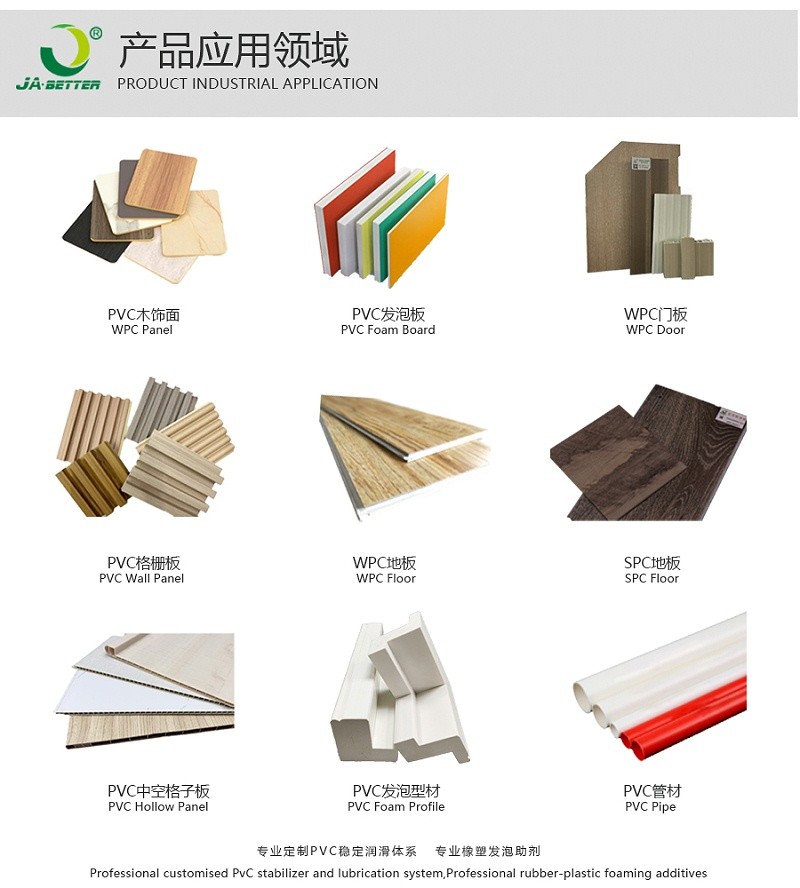
plastic building material additives. Targeting the processing and production challenges of WPC door panels and WPC door frames, the company has developed dedicated WPC door panel stabilizers and WPC door frame stabilizers, fully meeting the large-scale production needs of wood-plastic door accessories. With years of in-depth experience in the building material additive industry, Jabetter focuses on the process optimization of WPC door panel production and continuously optimizes the formula of matched WPC door panel stabilizers. By adjusting additive parameters according to raw material characteristics of different production areas, the company solves various common problems in the extrusion molding of WPC door panels.
Jabetter also delves into the field of WPC door frame additives, selectively optimizing the formula system of WPC door frame stabilizers to adapt to the production of WPC door frames with various special-shaped cross-sections and ensure the stability of the WPC door frame production process. The company conducts on-site investigations of factory production conditions, optimizes additive performance based on customers’ production line equipment, enables WPC door panel stabilizers to adapt to various foaming processes, and allows WPC door frame stabilizers to match continuous extrusion production lines. Centering on actual production demands, Jabetter continuously iterates and upgrades the performance of additive products, providing reliable additive solutions for manufacturers of WPC door panels and door frames.
The production quality of WPC door panels is fundamentally supported by the performance of WPC door panel stabilizers, and high-quality and stable stabilizers are the key to consistent mass production quality of WPC door panels. The production of WPC door panels takes high-temperature extrusion plasticization as the core process. During production, resin raw materials are prone to thermal decomposition, which easily causes surface discoloration and defects on WPC door panels. Professional and matched WPC door panel stabilizers can effectively inhibit the thermal decomposition of resins, stabilize the melt state of WPC door panels, achieve more uniform plasticization, and avoid common quality problems such as color difference, black spots and cracks.
WPC door panels mostly adopt high wood powder filling formulas, and poor raw material compatibility is a common production pain point. Premium WPC door panel stabilizers can improve the fusion degree of wood powder and resin, optimize the internal cell structure of WPC door panels, and deliver uniform texture and stable performance. Failure to select matched WPC door panel stabilizers will lead to incomplete plasticization, profile deformation, inconsistent batch quality and other defects in WPC door panels. These problems will not only increase production waste, but also affect subsequent processing procedures including film coating, cutting and assembly, greatly reducing production efficiency and finished product qualification rate.
Supporting the production of WPC door panels, WPC door frames have exclusive requirements for additive performance, and professional WPC door frame stabilizers are the core guarantee for the molding and service quality of WPC door frames. Most WPC door frames are special-shaped solid profiles with higher extrusion molding difficulty. Matched WPC door frame stabilizers can improve material fluidity, enable complete molding of WPC door frames with complex cross-sections, and eliminate defects such as material shortage, burrs and rough surfaces.
As the load-bearing structure of door bodies, WPC door frames are susceptible to deformation caused by changes in temperature and humidity during long-term use. High-quality WPC door frame stabilizers can enhance the compactness of the profile structure, improve the dimensional stability of WPC door frames, and effectively resist deformation and warpage caused by environmental factors. Many manufacturers adopt general stabilizers instead of dedicated WPC door frame stabilizers, resulting in poor temperature resistance, easy discoloration and prominent deformation after long-term storage of finished door frames. The accurate selection of dedicated WPC door frame stabilizers can adapt to the high-filling production system of WPC door frames, simplify production commissioning procedures, stabilize finished product quality, and reduce production losses and costs for enterprises.
WPC door panel stabilizers and WPC door frame stabilizers have different performance focuses and cannot be used interchangeably. Manufacturers need to select products accurately according to product categories. WPC door panels are mainly foamed plate structures, and corresponding stabilizers focus on optimizing foaming effect and melt strength to ensure lightweight and structural stability of plates. WPC door frames are mainly solid special-shaped structures, and their dedicated stabilizers prioritize improving molding accuracy and long-term dimensional stability to meet load-bearing service requirements.
The WPC door panel stabilizers and WPC door frame stabilizers developed by Jabetter have undergone a large number of production line tests and adjustments, adapting to different raw material ratios and production equipment, and can comprehensively optimize the production processes and overall product quality of WPC door panels and door frames. Amid the standardized development of the wood-plastic building material industry, the rational selection of professional WPC door panel and door frame stabilizers is an important way for enterprises to stabilize product quality, improve production efficiency and consolidate market competitiveness, boosting the standardized and long-term sustainable development of the WPC door accessory industry.
☁ 网络:http://www.jbtpvc.com/
☎WhatsApp:008618963029813
✉电子邮件:info@Jabetter.com
#PVC_stabilizer #PVC_foaming_agent#PVC_processing_aid#WPC_additive#PVC_lubricant#Chemicals#Chemical_auxiliary_agent#PVC#PVC_additives
#PVC_stabilizer #PVC_foaming_agent#PVC_processing_aid#WPC_additive#PVC_lubricant#Chemicals#Chemical_auxiliary_agent#PVC#PVC_additives
